Why build a Zero Carbon home
We are in a climate emergency and the construction industry has a significant role to play. As an action building or renovating a home or building is likely to be one of, if not the single largest opportunity for you to minimise your carbon footprint in your lifespan.
That is why we always encourage every project to be the best it can be and to offset the remaining emissions through onsite planting, biodiversification and energy.
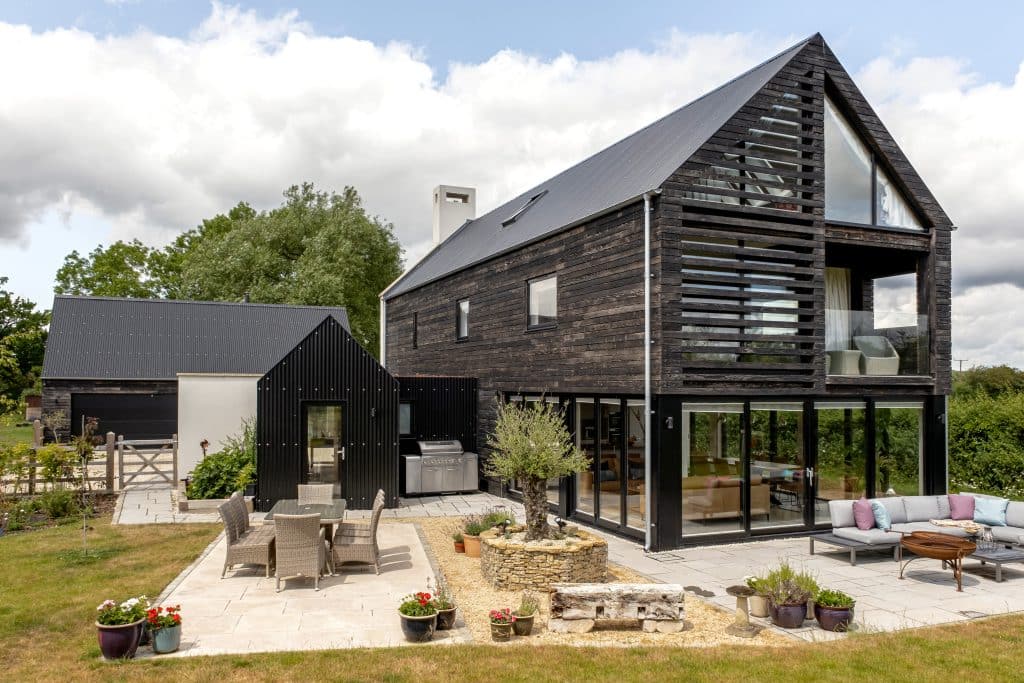
What do we mean when we refer to a net zero carbon home?
This is an emerging and hence evolving field but things are progressing rapidly. When we talk of carbon we are referring to equivalent volumes of CO2, not just carbon itself, but the wider greenhouse gasses and their climate impact. Methane for instance has a much higher potential to warm our atmosphere. To allow us to analyse and compare data this is transferred into a single metric – CO2e.
The CO2e comes initially from the construction work and materials to build the structure – embodied carbon, then from its usage and maintenance – operational carbon. Finally, a sum is allowed for the future potential demolition and disposal of the building. There must be several assumptions based on wide scale averages in terms of how often users may change or replace the internal fixtures but as the data volume grows so will the accuracy of the calculations to allow us to target smaller factors.
Can we go further?
Yes, while we are looking to design buildings that produce no CO2e. We are at the same time trying to go further and to produce regenerative architecture that enhances the location in which it is being built, from excess electricity powering adjacent homes, true biodiversification within our landscaping schemes, accessible community spaces and craft proliferation every build project has an opportunity to positively improve its setting.
Community enhancement might be in the form of meeting spaces, public parks, orchards and other facilities that benefit not only our clients but their friends and neighbours.
Biodiversity enhancements might contradict community space by allowing areas which are not meant to be used by humans or their pets. These spaces (messy space as we call it) allow nature to given what happens. They can be great ways to use benign waste such as old concrete or timber to create the start of habitats which nature then takes over.
Craft proliferation seeks to educate the community through our actions to inspire others to take simple measures is their own homes or workplaces etc.
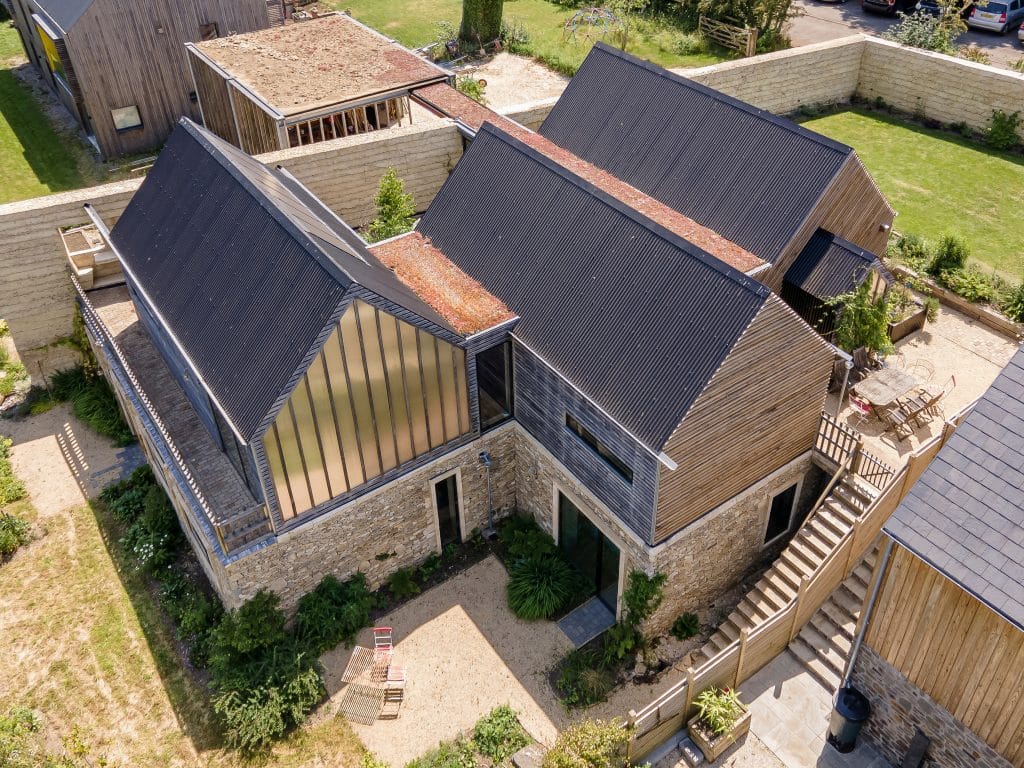
Passivhaus Services
Revolutionise your building with Artel31’s Passivhaus expertise. We work with experienced Passivhaus designers across our projects, offering anything from light-touch input on extensions to full house retrofits and eco new builds.
- Reduce energy costs by up to 90% with passive house design
- Achieve maximum energy efficiency and comfort
- Optimise your building for year-round temperature control
- Benefit from expert guidance throughout the design process
We can provide comprehensive support to create a building that meets the rigorous Passivhaus standards or simply take the lessons from it and embed them to a lesser degree as works with a specific scheme.
Whether you’re constructing a new home or retrofitting an existing property, by using Passivhaus design processes you will not only future-proof your investment, but also make a meaningful contribution to a greener, more sustainable world.
Our Services other than Passivhaus
- Lifetime Carbon Analysis including embodied, in use and ultimately reuse.
- Energy/insulation Surveys – looking at existing properties and creating a list of improvements to target in a certain order to maximise return to investment.
Chat with Artel31 and start designing smarter, greener spaces.
From our studio in Chippenham, our projects cover Wiltshire, Bristol & Bath, and further afield, from London to Cornwall. If you have something interesting, we don’t let geography get in the way…